
GPT-6 Cyber Finds 81 Firefox Flaws and Hundreds of Linux Vulnerabilities

GPT-6 Cyber is OpenAI’s specialized model for authorized cybersecurity research. Announced on November 5, 2026, it is designed to help researchers investigate vulnerabilities, validate their impact, and develop fixes while respecting the boundaries of a security assignment.
The announcement raises an important question: can more capable AI give defenders a useful lead over attackers? The answer depends on more than how many bugs a model finds. Researchers also need reproducible evidence, accurate prioritization, and fixes that actually reach users.
This overview separates published results from their practical implications. It is based on public documentation, not hands-on testing.
What Is GPT-6 Cyber?
The GPT-6 Cyber system card describes it as a cybersecurity-focused variant of GPT-6 Astra. Its training targets activities such as vulnerability discovery, exploit development, and web penetration testing.
An exploit is a method of using a software weakness to produce an unintended result. In authorized research, demonstrating exploitability can help establish that a suspicious bug is a real security problem.
That is different from simply asking a chatbot whether code “looks secure.” A useful investigation needs evidence: what fails, under which conditions, what an attacker could achieve, and whether a proposed fix addresses the problem.
GPT-6 Cyber Results: What Has OpenAI Reported?
According to the official GPT-6 Cyber announcement, the research includes:
| Reported result | Context |
|---|---|
| 81 previously unknown Firefox vulnerabilities | Classified as high severity by Mozilla |
| 948 Linux local privilege escalation exploits | Produced in a controlled research campaign |
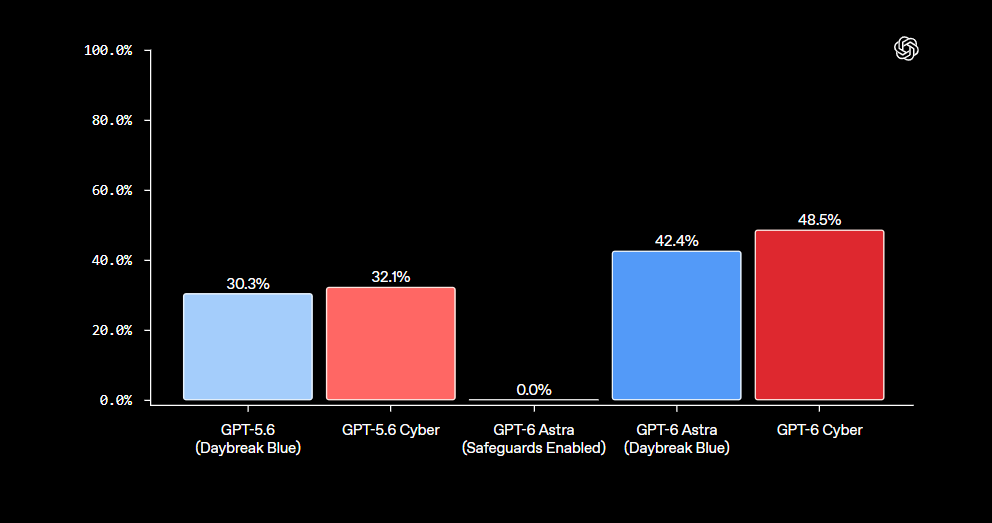
| 48.5% on ExploitGym | Compared with 32.1% for GPT-5.6 Cyber |
GPT-6 Cyber vs. GPT-5.6 Cyber: Reading the ExploitGym Chart
The chart compares five model and access configurations. GPT-6 Cyber scores 48.5%, compared with 42.4% for GPT-6 Astra with Daybreak Blue. That is a 6.1 percentage-point difference in this evaluation.
Access settings matter here: the same chart includes GPT-6 Astra with safeguards enabled at 0%. That result should not be read as proof that the underlying model has no cybersecurity knowledge. A chart mixing access configurations does not isolate model capability from restrictions on what the model will attempt.
These are published evaluation results, not independently reproduced findings from our own testing. They do not predict the percentage of vulnerabilities a team will find in an arbitrary codebase.
What the Firefox Findings Mean
Mozilla’s Firefox 159 security advisory provides a useful check against the product announcement. It lists numerous high-severity issues and credits OpenAI Codex Security for multiple reports.
The advisory includes different types of flaws, such as use-after-free errors and incorrect boundary conditions. A use-after-free problem involves software accessing memory after it has been released; the impact depends on how the faulty behavior can be triggered.
The important distinction is between discovery and protection. A researcher finding a vulnerability does not automatically protect every installation. A fix must be reviewed, released, and installed.
The advisory is evidence of a patching outcome, but it should not be used to claim that every reported finding is fixed in every Firefox edition or that every issue had already been exploited by criminals.
What Happened in the Linux Research?
OpenAI’s separate report, A thousand fewer paths to root, describes a campaign conducted in mid-October 2026:
- 2,308 candidate findings were analyzed.
- 1,724 vulnerabilities were reproduced.
- The work produced 948 distinct local privilege escalation results with candidate patches.
- The campaign used about $1.21 million in API credits.
Local privilege escalation means moving from limited access on a machine to stronger permissions. It does not mean every finding lets an attacker break into any Linux server remotely.
The report describes a sequence of discovery, reproduction, impact assessment, patch creation, and human review. It also acknowledges that some generated patches needed improvement.
These were controlled research activities, not a report of 948 attacks against customers. The campaign’s API bill is not a public subscription price for GPT-6 Cyber.
For security teams, the practical lesson is to distinguish a large queue of possible bugs from a smaller queue of validated, actionable findings.
OpenAI GPT-6 Cyber Access: Who Can Use It?
At launch, OpenAI said GPT-6 Cyber was available through the API and Codex to a selected group of approved Daybreak Red customers, with broader access planned within that program.
The Daybreak program accepts applications from individuals and organizations and reviews applicants and their intended use.
| Program | Stated focus |
|---|---|
| Daybreak Blue |
Defensive investigation, vulnerability validation, remediation, and threat modeling |
| Daybreak Red |
Advanced authorized testing, red teaming, and exploit validation |
An application is not an approval. Readers should check the official program before planning a workflow around access. Do not assume a regular ChatGPT subscription includes this specialized model.
How Well Does It Complete Authorized Security Tasks?
The system card also reports an evaluation of authorized task completion. GPT-6 Cyber scored 100% for general security assistance and patching, 96% for exploit development, and 97% for red teaming.
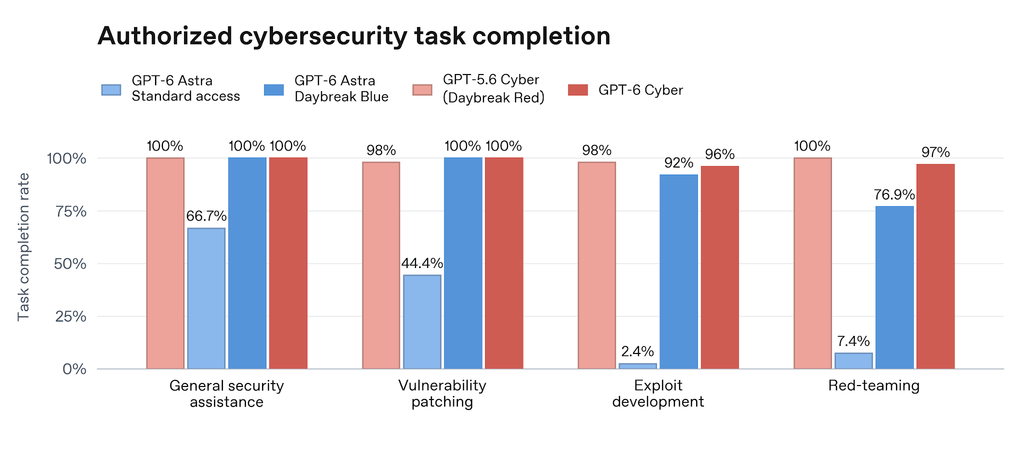
This chart answers a different question from ExploitGym. It concerns completion of authorized requests in a defensive-use evaluation, rather than the success rate of exploiting specified vulnerabilities. A 96% result here should not become a headline claiming that the model can exploit 96% of software.
For a security team, these figures are a reason to test the tool on representative work. Useful evaluation questions include whether the response addresses the assignment, produces verifiable evidence, and leaves a clear record for a reviewer.
What Does the “Critical” Cybersecurity Rating Mean?
OpenAI classifies GPT-6 Cyber as Critical in cybersecurity under its Preparedness Framework. This is a capability classification, not a declaration that every response is correct or that the product is malware.
The system card describes identity checks, organizational security requirements, and restrictions on use. It also reports an evaluation in which the model’s out-of-scope exploitation rate was 0.07% without deployment safety instructions and 0% with them.
Those results apply to the evaluated setup. They do not establish that the model can never act outside scope in a different environment. The documentation also acknowledges weaker performance on some measures, including how completely blockers are reported in final answers.
GPT-6 Cyber and GPT-6 Astra: What Do the Safety Scores Show?
| Category | GPT-6 Cyber | GPT-6 Astra |
|---|---|---|
| Violent Illicit behavior | 0.988 | 0.990 |
| Non-Violent Illicit behavior | 0.997 | 0.997 |
| Extremism | 0.957 | 0.979 |
| Hate | 1.000 | 1.000 |
| Self-harm (standard) | 0.984 | 0.992 |
| Gore | 0.738 | 0.646 |
| Sexual | 0.967 | 0.980 |
| Sexual/minors | 0.965 | 0.974 |
The results vary by category. For example, both models score 1.000 in the hate category, while GPT-6 Cyber scores 0.738 versus Astra’s 0.646 in the gore category. Other rows favor Astra numerically. OpenAI says the listed numerical regressions are not statistically significant.
This table is about response safety, not vulnerability discovery or protection from cyberattacks. A score of 1.000 on a test set is not a guarantee of flawless behavior in every future conversation.
Why Benchmarks Are Only Part of the Story
A benchmark answers a defined question under specified conditions. A production security program has additional questions to answer.
Before relying on a finding, a reviewer should ask:
- Does it reproduce? A plausible explanation is not sufficient evidence.
- Does it affect our deployment? Version, configuration, and exposure matter.
- Is the proposed impact supported? A crash and a full compromise are different outcomes.
- Does the fix hold up? Passing one test does not prove every related path is closed.
- Who owns the remediation? A report without a responsible team may remain unresolved.
This is our practical interpretation of the research, not an additional benchmark result. Faster discovery is valuable when the organization can also investigate and resolve the findings.
What Should Everyday Users Do?
You do not need access to GPT-6 Cyber to benefit from a vendor releasing a security fix. Your immediate task is to keep supported software updated.
For Firefox downloaded directly from Mozilla, open Help → About Firefox on Windows, or Firefox → About Firefox on macOS, check for an update, and restart when prompted. Linux package-manager installations and Microsoft Store installations follow their respective update channels.
Follow Mozilla’s official update instructions rather than downloading a “security fix” from an unfamiliar advertisement or message.
For workplace devices, follow your organization’s update process instead of bypassing its controls.
Will GPT-6 Cyber Replace Security Analysts?
The published work does not establish that security teams can be replaced. Our assessment is that the most useful role is assistance with investigations whose results people can verify.
A researcher still needs to define what is authorized, decide what evidence is sufficient, and communicate findings to the people responsible for a fix. A business also needs to weigh downtime, compatibility, and operational risk before deploying changes.
For cybersecurity students, that makes foundations such as networking, operating systems, secure coding, and clear reporting worth learning. Knowing how to assess an AI-generated claim is a more durable skill than simply knowing how to request one.
Final Thoughts
GPT-6 Cyber is worth watching because it connects vulnerability research with validation and remediation. Its value should be judged by confirmed findings and deployed fixes, alongside the controls used to keep testing authorized.
For readers, keep software current. For security teams, treat model output as evidence to investigate, not a substitute for accountable review.
Frequently Asked Questions
Is GPT-5.6 Cyber available?
Yes. OpenAI lists GPT-5.6 Cyber as available to all Daybreak Red customers for authorized cybersecurity work. Access requires approval through the program; a regular ChatGPT subscription does not automatically include it.
Is GPT-6 available yet?
Yes. GPT-6 is available to eligible users, although access depends on the model, subscription, and product. GPT-6 Cyber has separate restrictions, with initial access offered to selected Daybreak Red customers and broader access planned.
What is GPT-6 capable of?
Capabilities vary by model. GPT-6 Astra supports complex professional tasks, including reasoning and computer use. GPT-6 Cyber specializes in authorized security research, including discovering vulnerabilities, validating exploits, and helping develop fixes. Its outputs still require verification.
Who can access GPT-6 Cyber?
GPT-6 Cyber access is restricted through OpenAI’s Daybreak Red program. Approval involves identity verification, use restrictions, and security requirements. Daybreak Red membership does not automatically mean GPT-6 Cyber is enabled for your organization.
How do I use GPT-6 Cyber?
Apply for Daybreak Red access and confirm that your organization has approval for GPT-6 Cyber. Approved customers can use supported API or Codex workflows after completing the required setup. Testing must stay within the systems and activities you are authorized to assess.
Is GPT-6 Cyber better than GPT-5.6 Cyber?
OpenAI reports that GPT-6 Cyber scored 48.5% on ExploitGym, compared with 32.1% for GPT-5.6 Cyber. That is a 16.4 percentage-point improvement on this benchmark. It does not guarantee better results on every security task or codebase.